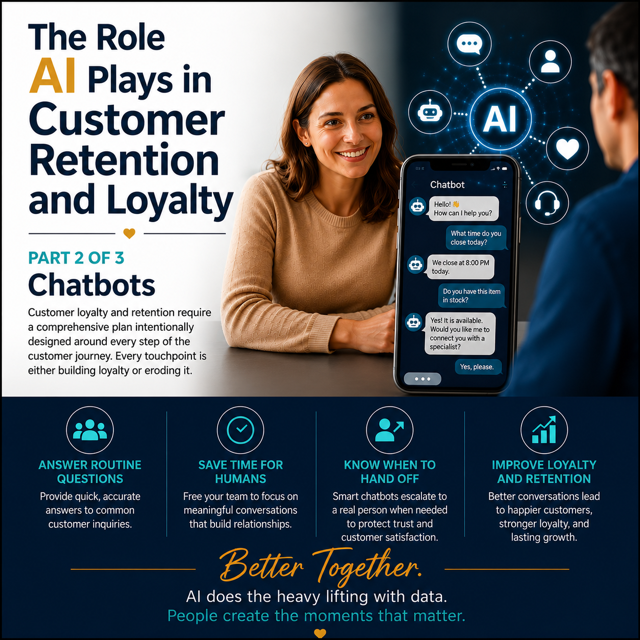
Part 2 of 3 Chat-Bots
Customer loyalty and retention require a comprehensive strategy intentionally designed around every step of the customer journey. Every touchpoint is either building loyalty or eroding it.
So where does AI fit?
In Part Two of this three-part series, we’ll focus on chatbots and how intelligent technology can support a stronger customer loyalty and retention strategy.
What Is a Chatbot?
A chatbot is an automated conversation tool that uses pre-programmed responses, artificial intelligence, or a combination of both to answer questions, provide support, and guide customers through common interactions.
A chatbot can be a valuable first step in the customer journey, especially when customers need quick answers to routine questions. But it should enhance the human experience—not replace the moments where empathy, judgment, and personal connection matter most.
Notice the key words:
common interactions and
routine questions.
Questions like:
-
- “What time do you close today?”
-
- “Is this car still available?”
-
- “Is this house on the waterfront?”
-
- “What flavors of ice cream do you have today?”
These are ideal chatbot interactions. Customers appreciate getting immediate answers, and employees are freed up to focus on higher-value conversations.
The problems begin when customers ask questions that fall outside those routine interactions.
Knowing When to Hand Off
One of the most important things you can teach a chatbot is
when to stop being a chatbot.
Recently, I started an online chat with a company where I was placing an order. The chatbot immediately introduced itself and explained that if it couldn’t help me, it would transfer me to a live agent.
After asking the same question four different ways—and receiving essentially the same canned response each time—I could feel my frustration growing. Finally, I reminded the chatbot of its original promise: if it couldn’t answer my question, it would transfer me to a live representative.
Only then was I connected to a real person, who answered my question in less than a minute.
That experience made me wonder:
How many customers would have simply left and purchased from someone else?
Your Chatbot Is Part of Your Customer Journey
If customers are abandoning conversations with your chatbot—and leaving your website—you have a customer experience problem, not just a technology problem.
Organizations should monitor chatbot conversations, website abandonment, and recurring customer questions. Those insights should be used to continually improve the chatbot’s knowledge base, responses, and escalation rules.
Depending on your platform, those updates may be made by your software provider or by someone within your organization. Either way, someone needs to own the process.
AI is only as effective as the information it has been given and the guidance it receives. When mistakes occur—especially the same mistakes repeatedly—they should be identified, corrected, and used to improve future interactions.
Sometimes the best answer isn’t another automated response.
Sometimes the best answer is simply,
“Let me connect you with someone who can help.“
Not Every Brand Should Use Chatbots
There are also organizations where chatbots may not be appropriate at all.
Luxury hospitality is a perfect example.
The Ritz-Carlton—widely recognized as one of the gold standards in customer service—wanted to give guests the convenience of texting their hotel. Rather than allowing a chatbot to respond, the company ultimately chose to have real employees answer guest messages through its mobile app.
The technology provided convenience, but the experience remained deeply personal.
That decision reflects an important principle:
Technology should support your brand promise, not redefine it.
Design AI Around Your Customer Experience
There is no one-size-fits-all approach to AI.
Every organization should intentionally decide if, when, and how AI will interact with customers. Those decisions should be part of a broader customer loyalty and retention strategy—not simply a technology initiative.
When implemented thoughtfully, AI can improve efficiency, reduce response times, and create a better customer experience.
When implemented carelessly, it can damage trust, frustrate customers, and quietly drive them to your competitors.
The difference isn’t the technology.
It’s the strategy behind it.
At Loyalty By Design, we help organizations map their customer journey and intentionally design customer loyalty and retention strategies that turn customer retention into their competitive advantage.
In part three of this three part series we will tackle the controversial topic of using AI for graphic design.